
ecotera home
AI-Enabled Water Contaminant Testing
From Field Data to Insight
Portable, AI smartphone-based microplastic / nanoplastic and environmental contaminant testing for rapid field monitoring and distributed water-quality data.
EcoExposure™ Water Platform: Easy as 1, 2, 3
1
Collect a Water Sample
Collect a sample from a tap, river, lake, ocean (salt water), or other water source.
2
Add the plant-based biodegradable Reagent
Add the EcoExposure test packet to your sample. The proprietary reagents interact with microplastic and nanoplastic particles revealing signals that are normally invisible in water.

3
TAKE A photo with your smartphone

After the reaction is complete, capture an image of the sample using the EcoExposure app. The system uses optical analysis, AI and computer vision tools to interpret environmental signals and help identify potential contaminants.


EcoExposure™ lets you test both microplastics and nanoplastics from the same sample — on-site, in real time, wherever you are.
It has been validated across diverse real-world matrices:
-
Tap water
-
Saltwater
-
Brackish water
-
Lakes and rivers across the US and beyond
With EcoExposure,™ a single person can process 20–40+ samples per day. By comparison, a 2026 systematic review of 355 microplastic studies (Nyadjro et al.) found that over 60% of studies collected fewer than 40 samples in total — often across several months.
Test Anywhere. Generate Data at Real-World Scale.

Click below for more information on Global Microplastic Literature.
Click on Interactive Map to See where EcoExposure™ has been tested.

Regulatory Momentum: Policy Drivers Creating Urgent Demand for Scalable Monitoring
U.S. EPA Draft CCL 6 Prioritizes Microplastics for Drinking Water
On April 2, 2026, the EPA and HHS announced the first group-level prioritization of microplastics on the draft Sixth Contaminant Candidate List. This initiates structured monitoring pathways under the Safe Drinking Water Act and highlights critical technical challenges: sparse particles follow Poisson statistics, small sample volumes create high false-negative risk, and reliable detection requires volume-aware sampling plus image-based approaches.
From Policy Prioritization to Scalable Monitoring: Characteristics Needed for Effective MNP Detection

A systematic review of 355 microplastic studies (2010–2022) shows most are single-timepoint with modest sample sizes (>60% of water studies collected <40 samples; <6% exceeded 200).
Conventional lab methods (FTIR, Raman, Py-GC/MS) deliver deep characterization but concentrate capacity in specialized facilities. Future large-scale programs require systems that are field-deployable, rapid, scalable, accessible to governments, utilities / NGOs/ researchers, repeatable for longitudinal data, and cost-effective.
EU Directive 2026/805: First Inclusion of Microplastics on EU Water Pollutant Watch Lists

Entered into force May 11, 2026, the first formal addition of microplastics to EU watch lists, updating the Water Framework Directive, Groundwater Directive, and Environmental Quality Standards Directive. All 27 Member States must transpose by December 2027, expanding expectations across surface water, groundwater, and wastewater. Existing lab methods are valuable for confirmation but face scalability, cost, and throughput constraints for high-frequency distributed monitoring.




We’ve extended the EcoExposure™ platform beyond drinking water and environmental samples into real-world consumer products. Recent technical notes demonstrate rapid optical detection across:
-
Fermented beverages (beer & kombucha)
-
Carbonated drinks (cola, clear soda, diet versions)
-
Dairy & plant-based matrices (milk, infant formula, oat milk, creamer)
-
Tannin-rich beverages (coffee, wine, tea, juices)
SPOTLIGHT: water intelligence everywhere
ecotera home x Global Decentralized Environmental Intelligence Network
02
NGO and Environmental Groups
Non-governmental organizations play a critical role in environmental monitoring and conservation. Portable testing tools allow NGOs to collect environmental observations across diverse ecosystems and communities.
These observations can support conservation programs, environmental education, and pollution response efforts.

01
Government & Environmental Agencies
EcoExposure™ supports environmental monitoring initiatives conducted by public agencies and regulatory organizations.
Accessible sensing tools can help expand water quality observations across rivers, drinking water systems, and coastal environments. Potential applications include pollution tracking, infrastructure monitoring, and environmental assessment programs.

04
Environmental Research and Citizen Science
Portable sensing technologies allow researchers and community scientists to conduct environmental testing outside traditional laboratories.
Field-based environmental assays can support studies of microplastics, turbidity, heavy metals, PFAS, and other emerging contaminants.

03
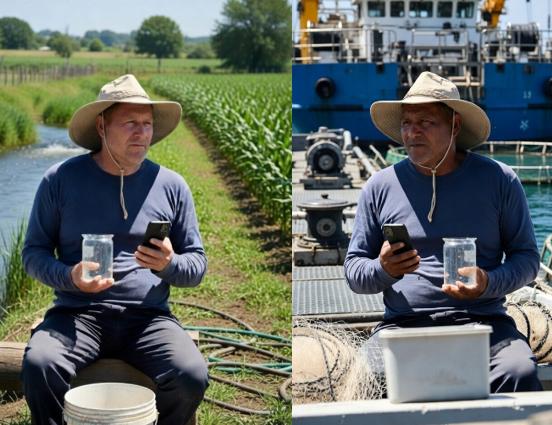
Agriculture and Fisheries Monitoring
Farmers, fishermen, and aquaculture operations depend on water quality for crops, livestock, and fisheries.
EcoExposure enables portable environmental testing that can be used directly in agricultural systems, irrigation networks, rivers, and coastal waters to monitor changing environmental conditions.
Reserve your EcoExposure™ Water Kits
Validated in tap water, rivers, lakes, and saltwater.
20–40+ samples per person per day.
No training needed.
Easy as 1,2,3.
Get In Touch
hello@ecoterahome.com