Rapid Distributed Seine River Microplastic / Nanoplastic Sampling Pilot — Paris, France

Abstract This technical note presents a rapid distributed shoreline sampling pilot conducted along the Seine River in central Paris, France. Using lightweight, low-infrastructure methods, five environmental water samples were collected from multiple publicly accessible micro-sites near the Louvre Museum, Pont du Carrousel, Quai Voltaire, and Musée d’Orsay within approximately 30 minutes.
This pilot served as an early field demonstration of the EcoExposure™ environmental assessment workflow, a portable smartphone-enabled platform designed for rapid decentralized environmental sampling and intact-liquid optical analysis under real-world outdoor conditions. The pilot demonstrates the operational feasibility of decentralized, shoreline-accessible sampling in a dense urban river environment without boats, pumps, or centralized laboratory support using EcoExposureTM platform. Key outcomes include rapid deployment, repeatable localized collections, and compatibility with portable field assessment workflows.
In the context of the EU Directive (EU) 2026/805 (effective 11 May 2026), which for the first time mandates enhanced monitoring of microplastics in surface waters, this work illustrates practical methods for scalable, distributed environmental intelligence. Recent studies report median microplastic concentrations in the Seine of ~0.6 particles per liter (600 particles/m³), highlighting the relevance of accessible monitoring tools.
This pilot supports the development of EcoExposureTM and decentralized workflows for municipal/government, researcher, NGO, and citizen science capabilities for high-density, repeat urban water monitoring aligned with evolving European environmental regulations. This paper is also available at:
https://doi.org/10.5281/zenodo.20361744 Figure 1. Rapid distributed Seine River sampling pilot in central Paris, France. Environmental water samples were collected across multiple shoreline-accessible micro-sites near the Louvre Museum, Pont du Carrousel, Quai Voltaire, and Musée d’Orsay using a portable field workflow. Repeated collections at adjacent micro-sites demonstrated feasibility for rapid localized repeat sampling within an urban river environment.

Introduction
Environmental monitoring of urban waterways is increasingly important in the context of emerging European environmental and microplastic monitoring initiatives. However, conventional laboratory-based workflows for environmental sampling are often resource-intensive, centralized, and difficult to scale for dense geographic coverage or rapid repeat measurements.
This technical note describes a rapid distributed shoreline sampling pilot performed along the Seine River in central Paris, France using a lightweight portable environmental sampling workflow. The pilot was designed to demonstrate operational feasibility for rapid localized repeat sampling and decentralized environmental monitoring within a dense urban river environment.
Objective
The objective of this pilot was to evaluate the feasibility of performing rapid multi-site environmental water collection within a major urban setting using portable low-infrastructure methods compatible with distributed environmental intelligence workflows.
The pilot focused primarily on:
rapid deployment,
localized repeat sampling,
shoreline accessibility,
and operational scalability.
This pilot was not intended to serve as a regulatory environmental assessment or comprehensive chemical quantification study.
Methods
This pilot was conducted as an impromptu real-world field deployment using publicly accessible shoreline infrastructure along the Seine River. No boats, pumps, or dedicated sampling platforms were used. Sampling locations were constrained to shoreline-accessible regions where historic river access steps, ledges, or embankment structures permitted safe water collection from the river edge. These practical constraints reflect realistic conditions likely to be encountered during decentralized urban environmental monitoring operations.
Environmental water samples were collected from multiple shoreline-accessible micro-sites along the Seine River corridor near:
the Louvre Museum,
Pont du Carrousel,
Quai Voltaire,
and Musée d’Orsay.
Sampling locations were selected based on safe public shoreline access points, including historic river access steps and accessible embankment regions.
Representative sampling regions included:
Site A: 48.859196, 2.331467
Site B1/B2: 48.860097, 2.333079
Site C1: 48.858851, 2.334530
Site C2: 48.858771, 2.334248
Figure 1. Rapid distributed Seine River sampling pilot in central Paris, France.Environmental water samples were collected across multiple shoreline-accessible micro-sites near the Louvre Museum, Pont du Carrousel, Quai Voltaire, and Musée d’Orsay using a portable field workflow. Repeated collections at adjacent micro-sites demonstrated feasibility for rapid localized repeat sampling within an urban river environment.
Repeated collections at adjacent micro-sites demonstrated feasibility for rapid localized repeat sampling within an urban river environment.

Figure 2. Representative field conditions along the Seine River during environmental sampling operations. Sampling was performed under real-world outdoor conditions in central Paris without dedicated laboratory infrastructure, highlighting feasibility for decentralized environmental monitoring and rapid urban water assessment.
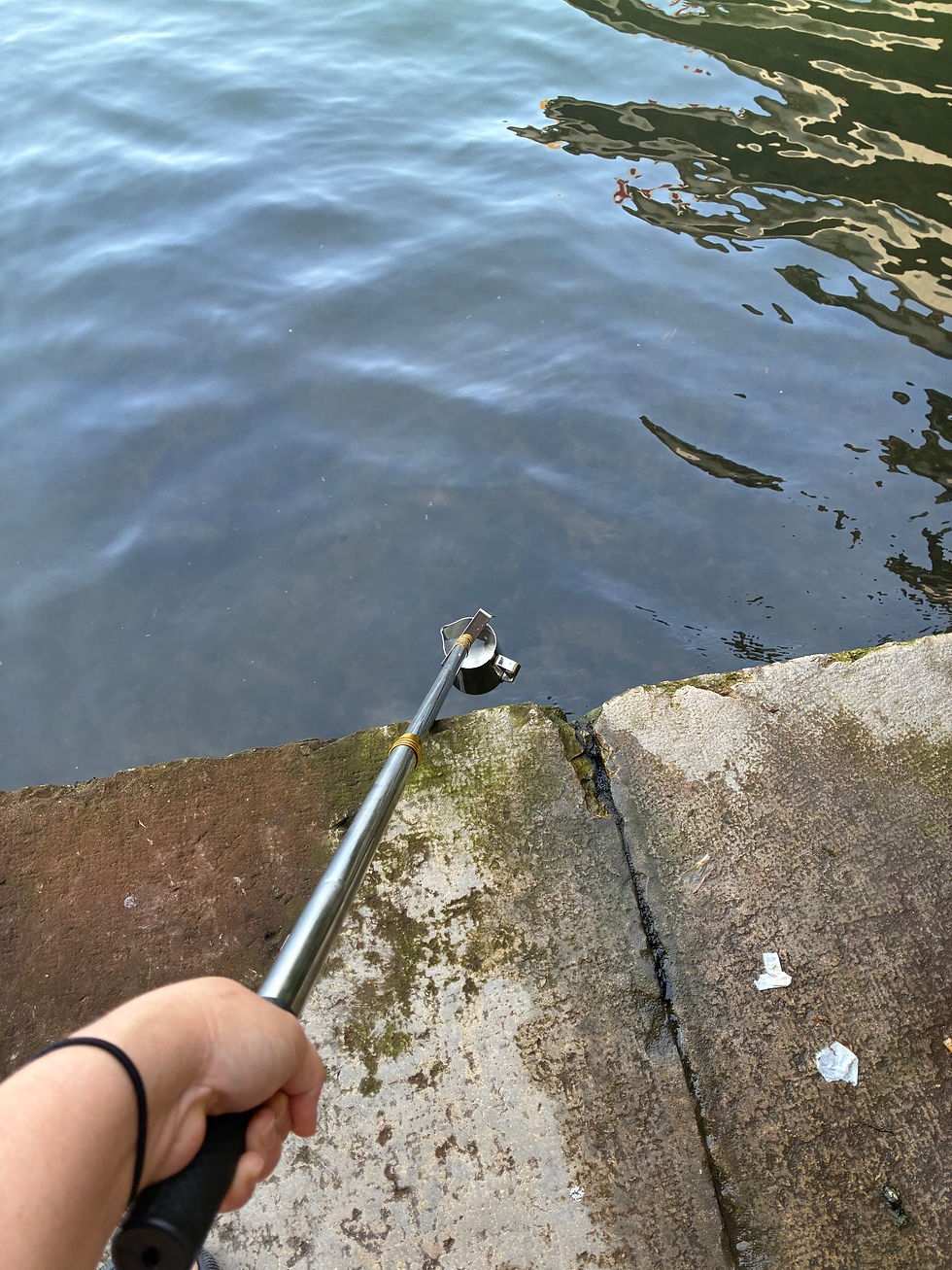
A lightweight extendable collection device was used to access river water from shoreline infrastructure. Samples were collected under real-world outdoor conditions without dedicated laboratory infrastructure or centralized analytical equipment.
Figure 3. Portable shoreline-accessible water collection workflow used for Seine River sampling. A lightweight extendable collection device enabled repeatable access to river water from public shoreline infrastructure and historic river access steps along the Seine River corridor.
Representative field workflows included:
shoreline-accessible sample collection,
intact-liquid environmental assessment,
portable patterned reference backgrounds,
and ambient outdoor lighting conditions.
Optional environmental clarification strategies were considered for future deployments, including coarse mesh or paper-based pre-filtration to remove large debris, sediment aggregates, algae, and macro-scale environmental interferents while preserving smaller suspended particulate fractions. Figure 4. Field-deployable assay setup for rapid environmental water assessment. Representative intact-liquid optical workflow performed adjacent to the Seine River using portable materials and reference backgrounds under ambient outdoor lighting conditions.

Results and Operational Observations
Five environmental collections were performed across multiple localized micro-sites within approximately 30 minutes of field activity along the Seine River corridor.
The pilot demonstrated:
rapid distributed environmental sampling feasibility,
repeatable shoreline-accessible collection,
low-infrastructure field deployment,
and localized repeat sampling capability.
The workflow was compatible with dense urban environmental conditions and required minimal equipment beyond portable collection and field assessment materials. Importantly, the pilot highlighted the practicality of performing geographically distributed environmental collection without the delays typically associated with centralized sample transport and laboratory processing workflows.
Discussion
This pilot supports the concept of decentralized environmental intelligence frameworks capable of enabling:
• rapid urban water assessments,
• repeated localized monitoring,
• citizen-science-compatible deployments,
• NGO and municipal field operations,
• and scalable environmental sampling density.
Localized repeat micro-site sampling may also support future studies involving:
• temporal repeat measurements,
• environmental event monitoring,
• shoreline heterogeneity analysis,
• and distributed environmental surveillance.
Microplastic and Nanoplastic ContextRecent studies of the Seine River provide important baseline context for plastic pollution in this urban waterway. A 2021–2022 study in the Greater Paris area reported a median concentration of approximately 600 microplastic particles per m³ (equivalent to 0.6 particles per liter), with a range of 14 to 4,700 particles per m³ (0.014–4.7 particles/L). Dominant polymer types included polypropylene (PP), polyethylene (PE), and polystyrene (PS). Annual transport was estimated at roughly 5.19 × 10¹² particles and 816 tons of microplastics. In the table, a comparison of different methodology and sampling approaches between Stratmann et al and present pilot are detailed.
Table 1. Comparison of Sampling Approaches: Stratmann et al. (2024) vs. Present Pilot
Aspect | Stratmann et al. (2024) Seine Study | Present Rapid Distributed Pilot (EcoExposure™ workflow) |
Study Duration | 4 campaigns over 1 year (July 2021 – July 2022) | Single pilot session (~30 minutes) |
Number of Sites | 7 sites (6 on Seine + 1 on Marne) | 5 micro-sites in central Paris (Louvre to Musée d’Orsay) |
Sample Volume | 74 L to 940 L per sample (large-volume pumping) | ~400 mL per sample (EcoExposure™ assay compatible) |
Sampling Method | In-situ cascade filtration pump (UFO system); 1–3 m from shore | Shoreline-accessible handheld extendable scoop/sampler |
Infrastructure | Specialized pumping equipment, boat/platform access likely required for some sites | No pumps, boats, or heavy equipment; fully portable |
Team Requirements | Multi-person research team for campaigns | 1 person (solo feasible) |
Analysis Turnaround | Laboratory processing (oxidation, density separation, µ-FTIR) – days to weeks | Rapid field assay + smartphone AI analysis (minutes) |
Scalability | High scientific rigor, lower spatial/temporal density | High operational scalability & repeat sampling density |
Primary Goal | Quantitative dataset for research & baseline | Demonstration of rapid, decentralized feasibility |
Broader European data from the Tara Microplastics Mission indicate the Seine carries approximately 900 microplastic particles per second past Paris, underscoring the scale of this invisible pollution.
Nanoplastics (<1 µm) represent a critical research gap. While no dedicated quantitative studies on nanoplastics in the Seine water column were identified, researchers note that nanoplastics are likely present as secondary breakdown products of microplastics, particularly in the river’s estuary (sometimes described as a “microplastic factory”). Advanced detection of nanoplastics remains technically challenging, highlighting the need for innovative, accessible monitoring tools.
Regulatory Context – EU Directive (EU) 2026/805On 11 May 2026, Directive (EU) 2026/805 entered into force, revising pollutant standards for surface and groundwater across the EU. For the first time, the directive explicitly addresses microplastics (alongside PFAS, pharmaceuticals, and antimicrobial resistance indicators), requiring improved monitoring under the Water Framework Directive framework.
This pilot demonstrates the practical feasibility of conducting rapid, low-infrastructure, shoreline-based sampling in dense urban environments such as central Paris. Such distributed methods are well-aligned with the directive’s emphasis on more comprehensive and scalable water quality monitoring. Portable workflows like the one tested here can support citizen science, municipal operations, and research initiatives seeking to generate the high-density, repeat data now encouraged at the European level.
EcoExposure™ (ecoterahome.com) offers a portable, smartphone-based assay platform designed to detect both microplastics and nanoplastics in field-collected water samples. By combining simple reagent-based preparation with AI-powered image analysis, it enables decentralized, rapid assessment compatible with the growing regulatory demand for micro- and nanoplastic monitoring.
While this pilot was limited in geographic scope and was not intended as a quantitative regulatory assessment, it demonstrates operational feasibility for rapid distributed environmental workflows within a major urban European river environment — capabilities that are increasingly relevant under evolving EU monitoring requirements.
ConclusionThis rapid Seine River pilot demonstrated that multiple shoreline-accessible environmental water collections can be performed efficiently within a dense urban setting using portable low-infrastructure methods.
The workflow supports future development of scalable distributed environmental monitoring systems aligned with emerging environmental surveillance, urban water intelligence initiatives, EcoExposure™ technology, and new EU regulatory expectations for microplastic and nanoplastic monitoring.
References1. Stratmann et al. (Seine Microplastics Study)
Stratmann CN, Dris R, Gasperi J, et al. Monitoring microplastics in the Seine River in the Greater Paris area. Front Earth Sci. 2024;12:1386547. doi:10.3389/feart.2024.1386547
2. Tara Microplastics Mission
Alarming microplastic pollution present in Europe’s great rivers. The Straits Times. April 7, 2025. Accessed May 24, 2026. https://www.straitstimes.com/world/europe/alarming-microplastic-pollution-in-europes-great-rivers
3. Tara Microplastics Mission (Scientific Background)
Fondation Tara Ocean. Mission Tara Microplastics. Accessed May 24, 2026. https://fondationtaraocean.org/en/expedition/tara-microplastics/
4. EU Directive
Directive (EU) 2026/805 of the European Parliament and of the Council of 30 March 2026 amending Directive 2000/60/EC establishing a framework for Community action in the field of water policy, Directive 2006/118/EC on the protection of groundwater against pollution and deterioration and Directive 2008/105/EC on environmental quality standards in the field of water policy. Off J Eur Union. 2026;2026/805. https://eur-lex.europa.eu/eli/dir/2026/805/oj/eng
No dedicated quantitative studies on nanoplastics in the Seine River water column were identified in the current scientific literature.


Comments