Image-Based Turbidity Analysis in Natural Water Systems: A Scalable Smartphone Framework

Abstract Turbidity, a measure of water clarity influenced by suspended particles, serves as a widely used proxy for water quality in environmental and industrial systems. Traditional nephelometric sensors and laboratory instruments, while quantitative, limit scalability and spatial coverage. This paper proposes an image-based framework for turbidity analysis using ubiquitous smartphone cameras. By extracting visual features such as clarity, light scattering, edge definition, and spatial heterogeneity, the approach enables large-volume sampling, distributed data collection, and seamless integration with environmental context. The framework complements Poisson-based sampling strategies and supports real-time, low-cost monitoring via portable tools such as the EcoExposure app.
Keywords: turbidity, image-based analysis, smartphone monitoring, computer vision, water quality, citizen science, large-volume sampling
1. Introduction
Water clarity is governed by suspended particles, dissolved materials, and environmental factors that alter light propagation. Turbidity is a standard proxy for particulate load and is routinely monitored for drinking-water safety, environmental assessment, and industrial processes.
Conventional methods rely on nephelometric sensors or benchtop turbidimeters. Although accurate, these tools are point-based, equipment-intensive, and costly, restricting sampling density and real-time responsiveness. Smartphone imaging, paired with computer-vision techniques, offers a scalable alternative that captures spatial patterns across entire sample volumes.
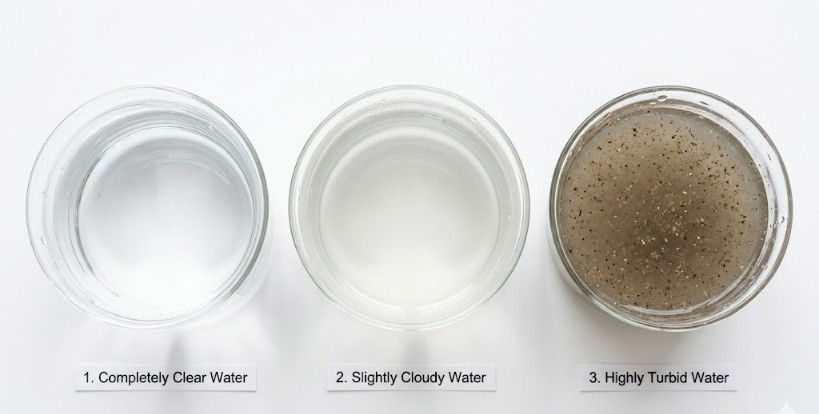
Figure 1.Representative images illustrating increasing turbidity in water samples, from clear to highly turbid conditions. Changes in clarity and light scattering reflect increasing concentrations of suspended particles and provide a visual basis for image-based analysis.
2. Limitations of Existing Methods
Current approaches have well-documented constraints:
Instrumentation dependence (specialized sensors or lab equipment)
Single-point measurements (no spatial heterogeneity)
Poor scalability (cost and logistics limit frequency)
Centralized workflows (delayed results)
These limitations underscore the need for distributed, high-density methods compatible with field conditions.
3. Proposed Approach: Image-Based Turbidity Analysis
This framework uses smartphone cameras to image water samples under ambient or controlled lighting. Visual features are extracted to quantify turbidity-related patterns without additional hardware.
Key advantages:
Ubiquitous imaging devices (smartphones)
Compatibility with large-volume containers or in-situ views
Field-deployable, no specialized optics required
Direct integration with computational pipelines and environmental metadata
The method serves as a pre-analytical, scalable layer that complements traditional turbidity meters and Poisson-based particle-counting strategies.
Visual Characteristics and Quantitative Proxies

5. Computer Vision Framework and Environmental Integration
Feature extraction draws on established computer-vision domains: intensity histograms, edge detectors (Sobel/Canny), texture analysis (GLCM), and lightweight CNN classifiers. Pre-processing (background subtraction, ROI selection) improves robustness.
A major strength is metadata fusion: each image can be tagged with GPS location, weather (precipitation, temperature), water source, and timestamp. This enables correlation of turbidity patterns with runoff events or seasonal variability, transforming isolated observations into spatiotemporal datasets.
6. Applications and Link to Large-Volume Sampling
Potential uses include:
Regional environmental monitoring
Citizen-science campaigns
Municipal/industrial process control
Research on particulate dynamics
When combined with Poisson statistics (Chu, this series), image-based methods directly visualize sparse-particle effects in large volumes, guiding users to collect statistically reliable samples via the EcoExposure app.
7. Conclusion
Image-based turbidity analysis provides a low-cost, scalable complement to traditional sensors. By leveraging smartphone cameras and computer-vision techniques, the framework supports high-density, context-aware monitoring of natural water systems. While calibration against certified turbidimeters remains essential for quantitative use, the approach is ready for deployment in citizen-science and field-research contexts and advances the goal of volume-aware, distributed environmental intelligence.
This paper is also available at: https://doi.org/10.5281/zenodo.19390542
References
Koydemir HC, et al. Smartphone-based turbidity reader. Sci Rep. 2019;9:19336. doi:10.1038/s41598-019-56474-z
Wilches LML, et al. Estimating water turbidity from a smartphone camera. In: Proc British Machine Vision Conf. 2022:880.
Rudy IM, Wilson AE. Turbidivision: a machine vision application for estimating turbidity from underwater images. PLoS One. 2024;19:e0305674. doi:10.1371/journal.pone.0305674
Soto IL, et al. An image-based water turbidity classification scheme using convolutional neural networks. Comput. 2025;13:178. doi:10.3390/computation13080178
Zhang D, et al. Smartphone-based turbidity estimation with inherent calibration. In: Proc IEEE Int Conf Acoust Speech Signal Process. 2023:1-5. doi:10.1109/ICASSP49357.2023.10216451


Comments