Field-Deployable Monitoring for Direct Potable Reuse: Expanding Water Reuse Safety Through Distributed Microplastic and Nanoplastic Detection

Abstract Water reuse, including Direct Potable Reuse (DPR), is an increasingly critical strategy for addressing water scarcity in regions such as Colorado. While treatment technologies have advanced significantly, monitoring frameworks have not evolved at the same pace—particularly for emerging contaminants such as microplastics (MPs) and nanoplastics (NPs). Current detection methods rely heavily on centralized laboratory workflows that are costly, time-intensive, and low-frequency, limiting their utility for real-time operational decision-making and public communication.
This paper proposes a complementary monitoring paradigm: field-deployable, distributed detection of MPs and NPs in intact liquid samples using rapid optical interaction methods (e.g., smartphone-compatible imaging with proprietary reagents and AI/computer vision analysis). By enabling high-frequency, scalable testing across reuse systems, this approach enhances transparency, supports operational insight, and strengthens public trust in DPR systems. The integration of distributed field measurements with centralized laboratory validation represents a practical pathway toward comprehensive monitoring coverage for modern water reuse infrastructure.
This paper is also available at:

Figure 1. Conceptual diagram of a water reuse system with distributed monitoring points.Sampling locations include influent, intermediate treatment stages (e.g., filtration, reverse osmosis, advanced oxidation), storage reservoirs, and distribution endpoints. Distributed monitoring enables continuous visibility across the reuse loop, supporting early anomaly detection and improved understanding of system dynamics, particularly for emerging contaminants such as microplastics and nanoplastics.
1. Introduction: Water Reuse Is Scaling Faster Than Monitoring Over the past several decades, water reuse has transitioned from pilot-scale experimentation to essential infrastructure. In Colorado, reuse programs date back to the 1960s, when Aurora and Colorado Springs began irrigating green spaces with non-potable recycled water. In the 1980s, Denver Water advanced the science by operating the nation’s first municipal-scale direct potable reuse pilot system. Today, nearly 30 Colorado cities recycle water.
The Colorado Water Plan identifies DPR as a key strategy to close projected supply-demand gaps in this semiarid state. WateReuse Colorado has led multi-year efforts to advance DPR science and public understanding, including the PureWater Colorado mobile demonstration (a carbon-based advanced treatment pilot that toured the state and engaged nearly 1,000 visitors). In November 2022, Colorado became one of the first states to adopt formal DPR regulations (Regulation 11), setting protective standards for treatment, monitoring, and public outreach.
As reuse systems scale (e.g., Aurora’s Prairie Waters delivering up to 10 million gallons per day of potable water from recycled sources, or Castle Rock Water’s Plum Creek facility targeting 33% of community supply by 2028) requirements for monitoring, verification, and public confidence grow. Treatment technologies (advanced filtration, reverse osmosis, disinfection, ozone, UV/AOP) perform strongly on known contaminants, but monitoring remains largely centralized, episodic, and laboratory-dependent. This gap is acute for emerging contaminants like microplastics and nanoplastics, where detection methods and frameworks continue to evolve.
2. The Monitoring Gap in Water Reuse Systems Current strategies feature low sampling frequency, centralized lab analysis, high per-sample costs, and multi-day-to-week turnaround times. These suit regulatory compliance but fall short for continuous insight, anomaly detection, distributed oversight, or public transparency.
For MPs and NPs, limitations are amplified: specialized labs, small sample volumes, and preprocessing (filtration, digestion) dominate. The absence of routine monitoring does not mean absence of the contaminants—it reflects current system constraints.
3. Microplastics and Nanoplastics in Reuse Contexts MPs (<5 mm) and NPs (sub-micron) are widespread in environmental waters, including all 16 Colorado water bodies sampled in a 2023 Front Range survey. In reuse systems they persist across treatment stages, fragment further, and may accumulate in recirculating flows—distinct from open systems. Conventional wastewater treatment plants (WWTPs) typically remove 88–99% of MPs by particle count (primarily in primary/secondary stages), yet effluent still releases significant volumes due to high throughput, and NPs are more challenging to capture. Sludge concentration of removed particles adds another pathway if land-applied. DPR’s advanced trains (e.g., RO + AOP) offer higher removal potential, but real-time verification of residuals and system dynamics remains essential.

Figure 2. Conceptual representation of microplastic and nanoplastic dynamics in water reuse systems. Particles may persist through treatment stages, fragment into smaller sizes, and circulate within reuse loops, highlighting the need for continuous monitoring.
4. Limitations of Existing Detection MethodsLab workflows (filtration, digestion, FTIR/Raman spectroscopy, microscopy) are robust but slow (2–7+ days), expensive, expertise-heavy, and non-field-deployable. They do not support rapid decisions or high-frequency monitoring.
5. Field-Deployable Monitoring as a Complementary LayerA practical complement is rapid, field-deployable detection in intact liquid samples—no filtration or digestion required. Key traits include ~30-minute turnaround, direct analysis on unmodified water, and compatibility with portable/smartphone imaging systems enhanced by optical reagents and AI/computer vision. This high-frequency screening layer pairs with (but does not replace) lab methods.
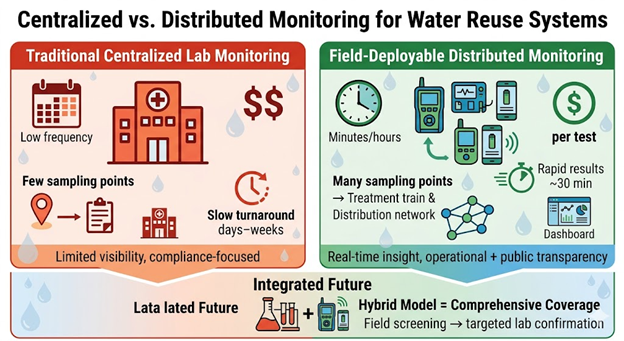
Figure 3. Centralized versus distributed monitoring frameworks for water reuse systems. Traditional water quality monitoring relies on centralized laboratory testing characterized by low sampling frequency, high per-sample cost, and delayed turnaround times. In contrast, distributed field-deployable monitoring enables high-frequency, multi-location sampling with rapid analysis. The integration of both approaches provides comprehensive system coverage, combining real-time operational insight with confirmatory laboratory validation.
6. Distributed Monitoring Networks: A New Paradigm Shift from few samples/few locations/low frequency → many samples/many locations/high frequency. Framework: Collect (multi-point sampling) → Analyze (on-site) → Map (spatial/temporal data) → Act (operational adjustments, targeted lab follow-up, communication).
7. Application to Direct Potable Reuse (DPR) DPR demands exceptional reliability, regulatory compliance, and public trust. Distributed monitoring delivers: • Increased transparency and data density for stakeholders. • Early anomaly detection. • Operational insight into dynamic particle behavior. • Demonstrable, ongoing verification that builds confidence—critical because perception of safety equals technical safety in DPR.
Colorado’s 2022 regulations and ongoing pilots (e.g., PureWater Colorado) underscore the need for such tools as the state moves toward broader adoption.
Figure 1. Conceptual diagram of a water reuse system with distributed monitoring points.Sampling locations include influent, intermediate treatment stages (e.g., filtration, reverse osmosis, advanced oxidation), storage reservoirs, and distribution endpoints. Distributed monitoring enables continuous visibility across the reuse loop, supporting early anomaly detection and improved understanding of system dynamics, particularly for emerging contaminants such as microplastics and nanoplastics.
8. Implementation Pathways 8.1 Utility-Level Deployment — Routine sampling at inflow, treatment stages, storage, and distribution. 8.2 Pilot Programs — Partnerships among utilities, researchers, and technology providers (e.g., alongside PureWater Colorado-style demos). 8.3 Data Integration — Dashboards linked to existing water-quality systems. 8.4 Public Engagement — Community-accessible testing and educational outreach.
Once established, this establishes a distributed monitoring framework: Collect → Analyze → Map → Act. High-frequency, multi-location sampling enables real-time system insight and supports operational decision-making.

9. Multi-User Applicability Applicable to consumers (point-of-use), utilities (operations), and industrial users—driving scalability and new data streams.
10. Conclusion
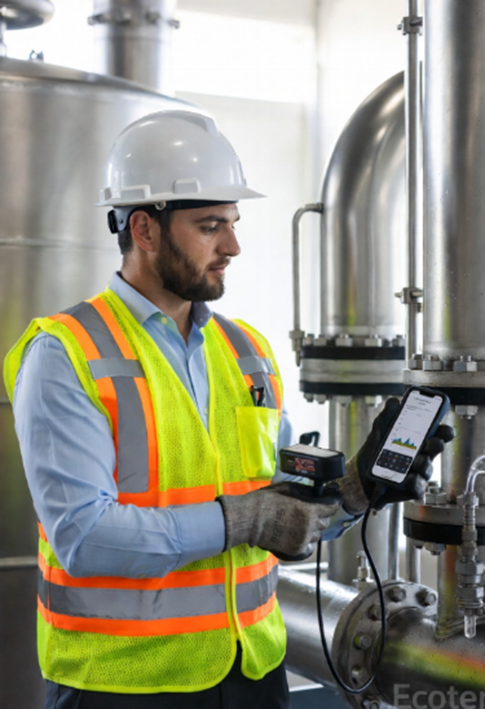
Water reuse is vital for Colorado and water-scarce regions facing drought, population growth, and Colorado River Basin pressures (statewide reuse currently ~3.6% of municipal wastewater). Treatment has advanced; monitoring must now catch up. Field-deployable, distributed approaches—exemplified by portable optical platforms that analyze intact samples via smartphone—provide scalable, high-frequency insight into MPs/NPs and other contaminants.
Combined with centralized lab validation, they deliver improved operations, transparency, and public confidence.
The future of water reuse monitoring is not centralized or distributed: it is both.
Keywords Water Reuse, Direct Potable Reuse, Microplastics, Nanoplastics, Distributed Monitoring, Field Testing, Water Quality, Environmental Monitoring, Optical Detection, Infrastructure, Colorado Water Plan
Selected References.
WateReuse Association. (2025). Profiles in Reuse: Colorado. https://watereuse.org/wp-content/uploads/2026/02/Profiles-in-Reuse-Colorado-2025.pdf
Colorado Department of Public Health and Environment. (2023). Regulation 11: Direct Potable Reuse. https://cdphe.colorado.gov/Regulation_11_Direct_Potable_Reuse
Environment Colorado. (2023). Colorado’s Waterways and Microplastics. May 2023.


Comments